15 Teaching Points from the LDN Support Group Pop-Up Live — An Evidence-Referenced Review
Dosing Nuance, Sensitive Clients, Pain Pathways, and What the Published Literature Does and Does Not Support
Yoon Hang Kim, MD, MPH
Board-Certified in Preventive Medicine | Integrative & Functional Medicine Physician
www.directintegrativecare.com
Disclaimer: This blog post is intended for educational and informational purposes only. It does not constitute medical advice, diagnosis, or treatment. The content is derived from a community teaching session and reflects general clinical discussion — not individualized recommendations. Low dose naltrexone (LDN) is used off-label for essentially all of the conditions discussed below; it is not FDA-approved for any of them, and much of the supporting evidence comes from small trials, open-label studies, or observational data. Always consult with a qualified clinician before starting, adjusting, or discontinuing any medication. Individual responses to LDN vary considerably.
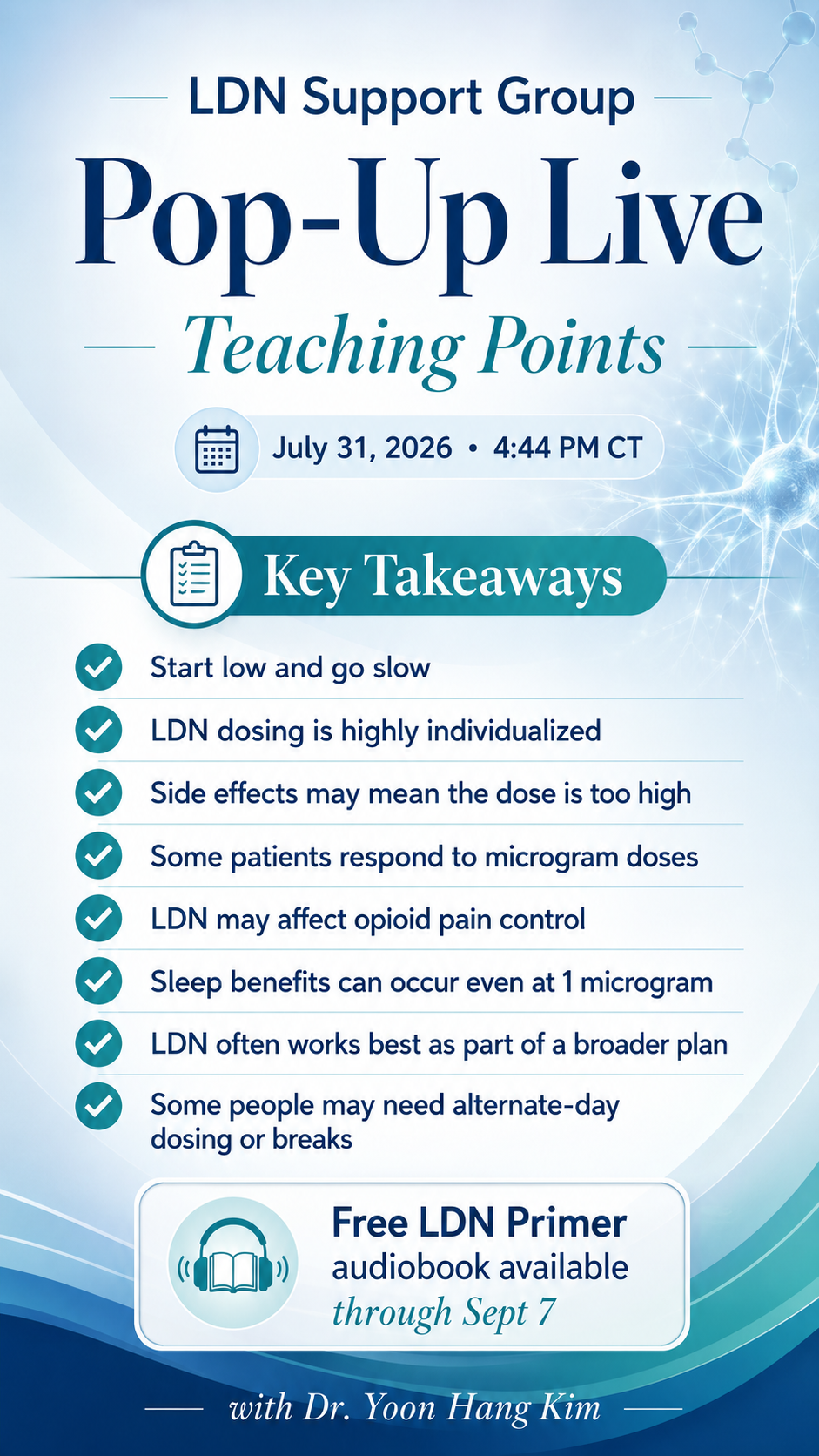
On July 31, 2026, the LDN Support Group hosted a Pop-Up Live session covering some of the most frequently misunderstood aspects of low dose naltrexone therapy. The conversation reinforced a consistent clinical theme: LDN is not a one-size-fits-all medication, and the details of dosing, titration, and integration into a broader care plan matter a great deal.
What follows is an expanded, reference-supported discussion of the 15 teaching points from that session. Where the published evidence is strong, this review says so. Where it is preliminary, mixed, or absent, it says that too. That honesty is not a weakness of LDN — it is the appropriate stance for any therapy still being actively studied, and it is what allows clients and clinicians to make sound decisions together.
1. LDN Dosing Is Highly Individualized
The commonly cited range of 1.5 to 4.5 mg comes largely from the trials that put LDN on the map — Jarred Younger and colleagues used 4.5 mg daily in their fibromyalgia work,2,3 and Jill Smith's Crohn's disease studies used the same dose.9,10 That range is a reasonable reference point, not a universal prescription. Some individuals — particularly those with heightened neurological or immune sensitivity — respond to microgram or lower doses, and the assumption that "more is better" is one of the most common and most consequential errors in LDN therapy.
Clinically, this means the prescriber must listen carefully to each client's response pattern. A dose that produces benefit in one person may produce intolerance in another. Individualization is the foundation of effective LDN therapy, not an optional refinement.
2. Rapid Titration Can Cause Problems
Increasing the dose too quickly is a frequent source of avoidable difficulty. Fatigue, disrupted sleep, vivid or disturbing dreams, brain fog, increased pain, rashes, or worsening of baseline symptoms may all signal that the pace of titration has outrun the body's capacity to adapt. Notably, sleep disturbance was the single most common side effect reported in Smith's Crohn's disease trial,9 and vivid dreams are among the most consistently reported early effects across the clinical literature.
When adverse symptoms appear during a dose increase, the first question should not be "How do I push through this?" but rather "Was this increase too fast or too high?"
A slow, patient titration — sometimes advancing by fractions of a milligram over weeks — may ultimately produce a better outcome than a rapid escalation to 4.5 mg.
3. When Symptoms Worsen, Consider Stepping Back
If a dose increase leads to a clear worsening of symptoms, it may be appropriate — depending on the individual and the prescriber's guidance — to pause LDN, allow the system to settle, and restart at a substantially lower dose. This is not a failure of treatment; it is a recalibration. In highly sensitive individuals, the restart dose may be dramatically lower than the dose that caused difficulty.
4. Initial Pain Can Occasionally Increase
Because naltrexone temporarily blocks opioid receptors — including the receptors through which the body's own endorphins provide pain relief — some individuals may experience a transient increase in pain when beginning LDN. The proposed pharmacology is a brief receptor blockade followed by a compensatory upregulation of endogenous opioid production and receptor density, a mechanism supported by animal work showing that intermittent opioid antagonism increases opioid receptor expression.1 Understanding this can help distinguish an expected pharmacological response from a true adverse reaction. When it occurs, it is typically short-lived.
5. Daily Dosing Is Not the Only Approach
While nightly dosing is the most commonly studied protocol, some clients may benefit from alternate-day dosing or planned days off, particularly when there is concern about inadequate endorphin recovery between doses or when the initial rebound effect appears to diminish over time. The rationale follows directly from the proposed mechanism: if benefit depends on a cycle of temporary blockade followed by endorphin upregulation, then the recovery window between doses is itself a therapeutic variable. This is an area of clinical practice that outpaces the formal trial evidence, which has overwhelmingly used daily dosing.
Editor's note: Alternate-day and "drug holiday" strategies are grounded in mechanism and clinical experience rather than in controlled trials. They are reasonable to consider under a prescriber's guidance, but clients should understand this is pragmatic individualization, not a protocol validated in head-to-head studies.
6. LDN May Affect Opioid Pain Treatment
This point deserves clear emphasis and is one of the best-established safety considerations in the entire discussion. Because naltrexone occupies opioid receptors, morphine and other opioid analgesics may be substantially less effective in someone actively taking it. Perioperative guidance in the anesthesiology literature broadly recommends discontinuing oral naltrexone roughly 72 hours before elective surgery, with the recognition that its blocking effect is reduced by about half by that point.11,12 Just as importantly, after naltrexone is stopped, mu-opioid receptors may be transiently upregulated, so opioid responses can become unpredictable — creating a real risk of respiratory depression that warrants close monitoring.12
Any client taking LDN should carry this information and disclose it proactively to emergency, surgical, and anesthesia teams. This is a safety issue, not a matter of preference — and the decision about timing should involve the prescribing clinician, not be made unilaterally.
7. LDN May Support Several Pain Pathways
The potential analgesic applications of LDN extend beyond generalized pain relief. The Pop-Up Live discussion touched on neuropathic pain, visceral hypersensitivity, central sensitization, diabetic neuropathy, and neuroinflammation. The unifying mechanistic hypothesis is that at low doses, naltrexone acts less as a classical opioid blocker and more as a glial modulator and antagonist of Toll-like receptor 4 (TLR4) on microglia — dampening the release of pro-inflammatory cytokines such as TNF-α and IL-6 that drive and maintain central sensitization.1,4 A 2023 scoping review in Pain Medicine catalogued this rationale across a range of centralized pain conditions, including complex regional pain syndrome.4 Small studies have also explored refractory painful diabetic neuropathy13 and CRPS specifically.14 The multi-level activity — peripheral, central, and immune — may help explain why LDN sometimes helps pain that has not responded to single-mechanism drugs.
8. LDN Is Often Part of a Broader Plan
LDN works best integrated into a comprehensive, individualized plan rather than used as a standalone intervention. Nutrition, anti-inflammatory strategies, targeted supplementation, metabolic optimization, sleep, and movement are all relevant. From an integrative and functional medicine perspective, LDN is a tool — sometimes a powerful one — but not a substitute for addressing root causes. There is a coherent mechanistic thread here: if LDN's benefit derives substantially from reducing neuroinflammation,1,15 then it stands to reason that pairing it with other measures that lower inflammatory burden may be complementary. This remains a reasoned clinical strategy rather than a combination proven in controlled trials.
9. Topical LDN May Be an Option, but Results Are Inconsistent
Topical naltrexone has been explored for localized pain and dermatologic conditions, and it may be worth considering when oral LDN is not tolerated. However, response is less predictable than with oral dosing — absorption variability, compounding differences, and the general complexity of transdermal delivery all contribute. Both clients and clinicians should enter this option with appropriately modest expectations.
10. Sleep Benefits Can Occur at Extremely Low Doses
One striking example from the Pop-Up Live involved a highly sensitive client who reported easier sleep onset, fewer nighttime interruptions, and more restorative sleep while taking only 1 microgram of LDN — that is 0.001 mg, roughly one four-thousandth of the traditional 4.5 mg ceiling. Improved sleep quality has been a recurring secondary finding in the formal literature as well: it appeared as a secondary outcome measure in Younger's fibromyalgia trial,3 and pooled observational data in long COVID have shown a moderate favorable effect on sleep.7 The single-microgram observation is a clinical anecdote, not trial data — but it is consistent with the broader theme that sensitive individuals may respond to inputs far below conventional dosing.
11. Some People May Not Tolerate LDN at Any Dose
While LDN is generally well tolerated, some individuals cannot tolerate it at any dose — even at microgram levels. This may occur in clients with severe sensitivity syndromes, mast cell activation syndrome (MCAS), or difficulty replenishing endorphins. Recognizing genuine intolerance matters: persisting in that situation is not therapeutic persistence but a source of harm. Stopping LDN and redirecting toward other supportive strategies is the appropriate response.
12. LDN May Have a Role in Immune and Neurological Regulation
The discussion included autoimmune conditions, MCAS, long COVID, ME/CFS, ADHD, autism-related symptoms, and neuroinflammation. The strongest published signals are in conditions with a clear inflammatory or neuroimmune component:
In Crohn's disease, an open-label pilot reported that 67% of participants achieved remission,9 followed by a small placebo-controlled trial showing improved mucosal healing.10 In multiple sclerosis, a placebo-controlled pilot found improvement in a mental-health quality-of-life measure.8 In fibromyalgia, Parkitny and Younger documented reductions in pro-inflammatory cytokines after eight weeks of LDN.5 In long COVID and ME/CFS, a systematic review and meta-analysis in BMJ Open pooling observational pre-post studies (n=155) found moderate-to-large favorable effect sizes for fatigue, pain, and sleep — while explicitly noting that no randomized controlled trials were identified, and rating overall certainty of evidence as low.7 Laboratory work has also shown that naltrexone can restore impaired TRPM3 ion-channel function in natural killer cells from ME/CFS and post-COVID patients, offering a plausible molecular rationale.16
The honest summary: responses vary considerably, the mechanistic case is genuinely interesting, and the clinical evidence ranges from suggestive to preliminary depending on the condition.
Editor's note on evidence quality: It would be a disservice to overstate the case. The early positive fibromyalgia studies were small and methodologically limited: the 2009 pilot enrolled 10 participants and was single-blind,2 and the 2013 crossover trial analyzed 28.3 The largest and most rigorous trial to date — 99 women randomized to 6 mg naltrexone (n=49) or placebo (n=50) for 12 weeks, published in The Lancet Rheumatology — did not find LDN superior to placebo for its primary pain outcome (between-group difference −0.34 on an 11-point scale; p=0.27), though the authors suggested a possible signal for memory worth investigating further.6 An accompanying editorial framed the result pointedly.18 A 2023 crossover trial had shown improvement in some quantitative sensory testing measures.17 Taken together, the fibromyalgia evidence is genuinely mixed. This does not mean LDN "doesn't work" — placebo-controlled trials in centralized pain are notoriously difficult, adverse-event rates in that trial were essentially identical between LDN and placebo (84% vs 86%), and many clients report meaningful benefit — but it does mean claims should be measured and expectations set honestly.
13. Pregnancy and Fertility Require Coordinated Care
LDN has been used in fertility and reproductive-immunology settings, and there is clinical experience supporting its use in selected cases. However, decisions about starting, continuing, or discontinuing LDN during pregnancy should always involve both the prescribing clinician and the obstetrician. This is not a decision to make unilaterally, and not one to base on another person's experience. The evidence base here is limited, the stakes are high, and coordinated care is non-negotiable.
14. Community Education Is Valuable — With Boundaries
The LDN Support Group exists because shared experience has genuine educational value. Observing patterns across thousands of individual reports — the community now exceeds 9,000 members — can surface signals no single clinician would encounter alone, and can reduce the isolation many people with chronic illness experience.
At the same time, pattern recognition is not the same as personalized clinical care. What worked for one person may be inappropriate, ineffective, or unsafe for another. Individualized medical decisions should be made in partnership with a qualified clinician who understands the client's full clinical picture — not copied from another person's protocol.
Free Resource: The LDN Primer Audiobook
The LDN Primer audiobook is available free through September 7, 2026. Written for general readers, it provides an accessible introduction to low dose naltrexone, its proposed mechanisms, and its clinical applications. For clinicians, researchers, and highly informed individuals seeking a deeper, referenced discussion, LDN for Clinicians offers a more detailed treatment.
15. Thank You to the Community
Every Pop-Up Live session is shaped by the questions and experiences participants bring. The willingness to ask thoughtful questions, share observations, and engage with nuance is what makes these sessions valuable — for the individuals asking and for the broader community. Thank you to everyone who joined the July 31, 2026 Pop-Up Live.
#LDN #LowDoseNaltrexone #LDNSupportGroup #IntegrativeMedicine #FunctionalMedicine #ChronicPain #MCAS #LongCOVID #Neuroinflammation #Fibromyalgia #CentralSensitization #TLR4 #EvidenceBasedMedicine
References
- Younger J, Parkitny L, McLain D. The use of low-dose naltrexone (LDN) as a novel anti-inflammatory treatment for chronic pain. Clin Rheumatol. 2014;33(4):451–459. doi:10.1007/s10067-014-2517-2. PMID: 24526250
- Younger J, Mackey S. Fibromyalgia symptoms are reduced by low-dose naltrexone: a pilot study. Pain Med. 2009;10(4):663–672. doi:10.1111/j.1526-4637.2009.00613.x. PMID: 19453963
- Younger J, Noor N, McCue R, Mackey S. Low-dose naltrexone for the treatment of fibromyalgia: findings of a small, randomized, double-blind, placebo-controlled, counterbalanced, crossover trial assessing daily pain levels. Arthritis Rheum. 2013;65(2):529–538. doi:10.1002/art.37734. PMID: 23359310
- Rupp A, Young E, Chadwick AL. Low-dose naltrexone's utility for non-cancer centralized pain conditions: a scoping review. Pain Med. 2023;24(11):1270–1281. doi:10.1093/pm/pnad074. PMID: 37302106
- Parkitny L, Younger J. Reduced pro-inflammatory cytokines after eight weeks of low-dose naltrexone for fibromyalgia. Biomedicines. 2017;5(2):16. doi:10.3390/biomedicines5020016. PMC5489802
- Due Bruun K, Christensen R, Amris K, et al. Naltrexone 6 mg once daily versus placebo in women with fibromyalgia: a randomised, double-blind, placebo-controlled trial. Lancet Rheumatol. 2024;6(1):e31–e39. doi:10.1016/S2665-9913(23)00278-3. PMID: 38258677
- Byambasuren O, Atkins TJ, Baptista S, Glasziou P, Chakraborty S. Effect of low-dose naltrexone for long COVID: a systematic review and meta-analysis. BMJ Open. 2026;16:e111253. doi:10.1136/bmjopen-2025-111253. (Institute for Evidence-Based Healthcare, Bond University; externally peer reviewed; literature searched through 5 May 2026. Certainty of evidence rated low by the authors. A separate, independent systematic review by Du A and Nguyen ADK reached broadly similar conclusions: COVID 2025;5(12):198, doi:10.3390/covid5120198.)
- Cree BA, Kornyeyeva E, Goodin DS. Pilot trial of low-dose naltrexone and quality of life in multiple sclerosis. Ann Neurol. 2010;68(2):145–150. doi:10.1002/ana.22006. PMID: 20695007
- Smith JP, Stock H, Bingaman S, Mauger D, Rogosnitzky M, Zagon IS. Low-dose naltrexone therapy improves active Crohn's disease. Am J Gastroenterol. 2007;102(4):820–828. doi:10.1111/j.1572-0241.2007.01045.x. PMID: 17222320
- Smith JP, Bingaman SI, Ruggiero F, et al. Therapy with the opioid antagonist naltrexone promotes mucosal healing in active Crohn's disease: a randomized placebo-controlled trial. Dig Dis Sci. 2011;56(7):2088–2097. doi:10.1007/s10620-011-1653-7. PMID: 21380937
- Agency for Healthcare Research and Quality (AHRQ) PSNet. A painful medication reconciliation mishap — perioperative naltrexone management. psnet.ahrq.gov (Oral naltrexone's blocking effect is reduced ~50% at 72 hours; discontinue ≥72 h before elective surgery.)
- Whately Y, et al. Perioperative management of patients on naltrexone. Australian and New Zealand College of Anaesthetists resource. (After discontinuation, selective mu-receptor upregulation may make opioid response unpredictable, raising respiratory-depression risk.) ANZCA
- Hota D, Srinivasan A, Dutta P, Bhansali A, Chakrabarti A. Off-label, low-dose naltrexone for refractory painful diabetic neuropathy. Pain Med. 2016;17(4):790–791. doi:10.1111/pme.12971. PMID: 26814256
- Chopra P, Cooper MS. Treatment of complex regional pain syndrome (CRPS) using low dose naltrexone (LDN). J Neuroimmune Pharmacol. 2013;8(3):470–476. doi:10.1007/s11481-013-9451-y. PMID: 23546884
- Patten DK, Schultz BG, Berlau DJ. The safety and efficacy of low-dose naltrexone in the management of chronic pain and inflammation in multiple sclerosis, fibromyalgia, Crohn's disease, and other chronic pain disorders. Pharmacotherapy. 2018;38(3):382–389. doi:10.1002/phar.2086. PMID: 29377216
- Sasso EM, Eaton-Fitch N, Smith P, Muraki K, Marshall-Gradisnik S. Low-dose naltrexone restored TRPM3 ion channel function in natural killer cells from long COVID patients. Front Mol Biosci. 2025;12:1582967. doi:10.3389/fmolb.2025.1582967.
- Bested K, Jensen LM, Andresen T, et al. Low-dose naltrexone for treatment of pain in patients with fibromyalgia: a randomized, double-blind, placebo-controlled, crossover study. Pain Rep. 2023;8(4):e1080. doi:10.1097/PR9.0000000000001080. PMC10789452
- Häuser W, Fitzcharles MA. Is low-dose naltrexone for fibromyalgia another treatment disappointment? Lancet Rheumatol. 2024;6(1):e5–e6. doi:10.1016/S2665-9913(23)00297-7. PMID: 38258679 (Invited commentary accompanying reference 6.)
All references above were verified against PubMed or publisher records, including a second independent verification pass of author names, journal, volume, page range, and PMID/DOI. Citations reflect the strength and limitations of the underlying evidence, including trials with negative as well as positive results. Preprint status is noted where applicable.
About Dr. Kim
Dr. Yoon Hang "John" Kim is a board-certified physician with over 20 years of experience spanning preventive medicine, integrative and functional medicine, medical acupuncture, and integrative holistic medicine. A fellowship-trained graduate of the University of Arizona Center for Integrative Medicine under Dr. Andrew Weil, Dr. Kim specializes in low dose naltrexone (LDN), autoimmune conditions, chronic pain, integrative oncology, fibromyalgia, chronic fatigue syndrome, mast cell activation syndrome (MCAS), and mold-related illness.
He is the author of three books and more than 20 published articles in integrative medicine.
Professional: www.yoonhangkim.com
Clinical: www.directintegrativecare.com

